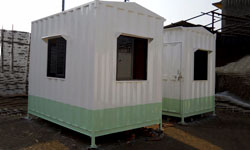
India is experiencing one of the largest construction booms in the world. Massive investments in highways, metro rail networks, airports, industrial corridors, smart cities, renewable energy, affordable housing, and logistics infrastructure are reshaping the nation’s skyline.
To deliver these ambitious projects on time and within budget, the construction industry is rapidly embracing prefab construction India as a faster, smarter, and more efficient alternative to traditional building methods.
Unlike conventional construction, prefabricated structures are manufactured in a controlled factory environment and assembled at the project site. This approach significantly reduces construction time, minimizes material waste, improves quality, and lowers labour dependency.
Today, prefab construction India is no longer limited to temporary site offices or portable cabins. It is being widely adopted for hospitals, schools, commercial offices, industrial buildings, warehouses, accommodation facilities, and government infrastructure projects.
At EECO Portable Solutions, we have witnessed this transformation firsthand by delivering portable cabins, modular offices, labour accommodation units, security cabins, sanitation blocks, and prefabricated buildings across Maharashtra.
In this guide, we’ll explore the seven powerful reasons why prefab construction is becoming the future of India’s construction industry.
What is Prefab Construction?
Prefab construction, also known as prefabricated or modular construction, is a method of manufacturing building components in a factory before transporting them to the final site for installation.
Instead of constructing every wall, roof, and room at the project location, prefab construction allows different building components to be produced simultaneously while the site is being prepared.
This dramatically shortens project timelines and improves quality consistency.
Common examples of prefab construction include:
- Portable Office Cabins
- Security Cabins
- Portable Toilet Blocks
- Labour Accommodation
- Modular Classrooms
- Portable Hospitals
- Prefabricated Site Offices
- Canteen Cabins
- Storage Cabins
- Glass Façade Cabins
- Modular Commercial Buildings
The popularity of prefab construction India continues to grow because it offers flexibility, scalability, and cost efficiency across multiple industries.
Why Prefab Construction India is Growing Rapidly
Several major trends are accelerating the adoption of prefabricated construction throughout India.
Government Infrastructure Investment
India’s National Infrastructure Pipeline (NIP) represents an investment of more than ₹111 lakh crore across transportation, housing, industrial development, ports, airports, railways, and smart cities.
Delivering projects of this scale requires faster construction methods than traditional brick-and-mortar techniques.
Prefabricated construction enables developers to complete projects more efficiently while maintaining consistent quality standards.
Rapid Urbanization
India’s urban population continues to expand every year.
This creates increasing demand for:
- Residential housing
- Commercial offices
- Educational institutions
- Healthcare facilities
- Industrial parks
- Warehouses
- Government buildings
Prefab construction provides a practical solution for meeting this growing demand while reducing project timelines.
Labour Shortages
Finding skilled construction workers has become one of the industry’s biggest challenges.
Factory-controlled manufacturing allows much of the work to be completed using specialized production teams instead of relying entirely on large on-site labour forces.
This improves productivity while maintaining consistent quality.
Sustainable Construction
Environmental regulations are encouraging developers to reduce waste and improve sustainability.
Compared to conventional construction, prefab construction India offers:
- Lower material waste
- Reduced dust pollution
- Less site disturbance
- Lower carbon emissions
- Better recycling opportunities
These advantages support green building initiatives and ESG commitments.
Reason 1 – Prefab Construction is Much Faster
The biggest advantage of prefab construction India is speed.
Traditional construction follows a sequential process.
First the foundation is completed.
Then walls are built.
Roofing follows.
Electrical work begins later.
Finally, plumbing, flooring, painting, and finishing are completed.
Each activity depends on the previous stage being finished.
Any delay immediately affects the overall project timeline.
Prefab construction completely changes this workflow.
While site preparation is underway, building components are simultaneously manufactured in a factory.
When the site is ready, completed modules are transported and installed.
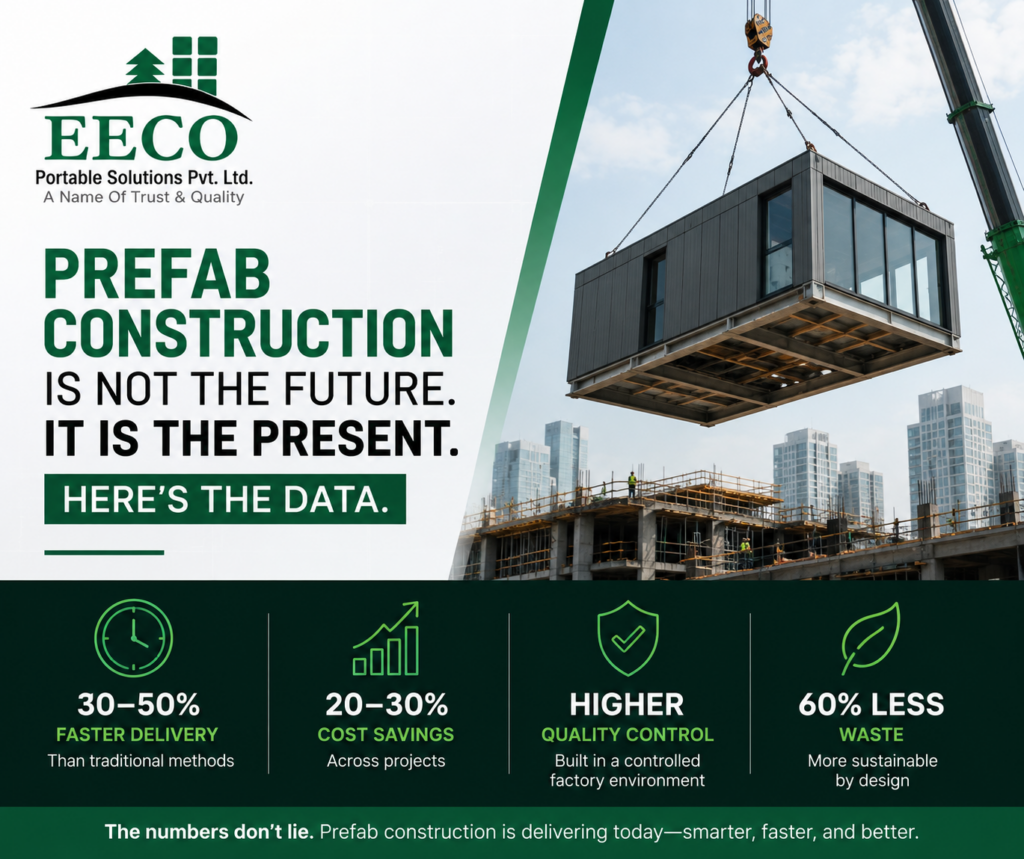
This parallel approach can reduce project completion time by 30–50%, depending on the project scope.
For construction companies working under strict deadlines, this reduction in project duration creates enormous financial benefits.
Faster Project Delivery Means Lower Costs
Completing projects earlier also reduces:
- Equipment rental
- Labour costs
- Site supervision
- Temporary utilities
- Financing costs
- Project overheads
For many developers, faster delivery generates savings that exceed the additional manufacturing costs associated with prefab construction.
Reason 2 – Lower Overall Construction Costs
Many buyers assume prefabricated buildings are only attractive because of lower material costs.
In reality, the biggest financial advantage comes from reducing the total project cost rather than simply lowering construction expenses.
Factory manufacturing minimizes:
- Material wastage
- Rework
- Construction delays
- Labour inefficiencies
- Equipment idle time
These improvements significantly reduce overall project expenditure.
Instead of evaluating only the purchase price, project owners should consider the complete lifecycle cost.
In many cases, prefab construction India delivers better long-term value than conventional construction.
Reduced Material Waste
Factory-controlled manufacturing uses computer-guided production methods that maximize material utilization.
Compared to traditional construction, prefab manufacturing generates substantially less waste because components are produced with greater accuracy.
Reduced wastage lowers costs while supporting environmentally responsible construction practices.
Reason 3 – Weather-Independent Construction
One of the biggest challenges facing the Indian construction industry is the monsoon season. Heavy rainfall often delays excavation, foundation work, concrete curing, masonry, and finishing activities, resulting in extended project timelines and increased costs.
One of the greatest advantages of prefab construction India is that manufacturing takes place inside a controlled factory environment. Production continues throughout the year, regardless of weather conditions.
This means contractors can continue manufacturing buildings even while the construction site is being prepared.
Once the site is ready, the prefabricated modules are transported and installed within a short period, significantly reducing weather-related delays.
Benefits During Monsoon
Prefab construction offers several advantages during India’s rainy season:
- Factory production continues uninterrupted.
- Less dependency on favourable weather.
- Reduced project delays.
- Better workforce productivity.
- Faster project completion.
- Improved planning and scheduling.
For infrastructure companies working under strict government deadlines, weather-independent construction provides a major competitive advantage.
Reason 4 – Superior Quality and Precision
Quality is one of the strongest reasons why developers are choosing prefab construction India over traditional building methods.
Conventional construction depends heavily on the skills of on-site labour, weather conditions, and manual supervision. These variables often lead to inconsistencies in workmanship.
Prefab construction eliminates many of these issues by manufacturing building components under controlled factory conditions using standardized production processes.
Factory-Controlled Manufacturing
Every component undergoes quality inspections before leaving the factory.
Benefits include:
- Uniform dimensions
- Better structural accuracy
- Higher finish quality
- Improved safety standards
- Consistent material quality
At EECO Portable Solutions, every portable cabin is manufactured using heavy-duty MS steel frames and quality interior finishes to ensure durability and long-term performance.
Better Structural Performance
Modern prefabricated buildings are engineered to meet demanding structural requirements.
Quality prefab structures offer:
- Corrosion-resistant steel
- Weather-resistant roofing
- High-quality insulation
- Secure electrical installations
- Long service life
These features make prefabricated buildings suitable for commercial, industrial, healthcare, educational, and government applications.
Reason 5 – Sustainable and Environment-Friendly Construction
Sustainability has become a key priority for the construction industry.
Government regulations, green building certifications, and environmental goals are encouraging developers to adopt more sustainable construction methods.
This is another reason why prefab construction India continues to gain popularity.
Reduced Material Waste
Traditional construction often generates significant waste due to:
- Excess material ordering
- On-site cutting
- Damaged materials
- Demolition waste
Factory manufacturing minimizes these issues through accurate material planning and precision production.
Many manufacturers report reducing material waste by up to 70–80% compared to conventional construction methods.
Lower Carbon Footprint
Prefab construction also helps reduce environmental impact by:
- Lower fuel consumption
- Reduced transportation of raw materials
- Better recycling of manufacturing waste
- Lower dust pollution
- Reduced site disturbance
These benefits contribute to greener and more sustainable infrastructure development.
Reusable Buildings
Unlike permanent concrete structures, many prefabricated buildings can be dismantled, relocated, and reused for future projects.
Portable offices, security cabins, labour accommodation, and storage cabins can easily be transported to new project locations, extending their useful life and improving return on investment.
Reason 6 – Flexible and Scalable Construction
Another major strength of prefab construction India is its flexibility.
Whether you require a small security cabin or a complete modular office complex, prefabricated buildings can be designed according to project requirements.
Applications Across Multiple Industries
Prefab construction is widely used in:
Construction Industry
- Site office cabins
- Labour accommodation
- Portable toilets
- Security cabins
- Material storage units
Industrial Sector
- Factory offices
- Warehouses
- Quality control labs
- Worker accommodation
- Equipment storage
Healthcare
- Temporary hospitals
- Clinics
- Diagnostic centres
- Medical laboratories
- Emergency facilities
Education
- Classrooms
- School offices
- Libraries
- Computer labs
- Training centres
Commercial Projects
- Sales offices
- Reception areas
- Retail outlets
- Modular offices
- Customer service centres
This flexibility makes prefab construction suitable for projects of every size.
Easy Expansion
One advantage rarely available in traditional construction is easy expansion.
As project requirements change, additional modular units can simply be added without demolishing existing structures.
This allows businesses to grow their infrastructure gradually while minimizing disruption.
Reason 7 – India’s Infrastructure Growth Demands Prefab Construction
India is investing heavily in infrastructure development through:
- National Infrastructure Pipeline (NIP)
- Smart Cities Mission
- PM Gati Shakti
- Industrial Corridors
- Affordable Housing Projects
- Metro Rail Expansion
- Renewable Energy Projects
Completing these large-scale developments using only traditional construction methods would require enormous labour resources and extended construction timelines.
Prefab construction solves these challenges by enabling:
- Faster project delivery
- Better resource utilization
- Lower labour dependency
- Improved quality
- Standardized construction
As India’s infrastructure ambitions continue to grow, prefab construction India will become an increasingly important part of the country’s development strategy.
Emerging Technologies Driving Prefab Construction India
Modern prefabricated construction is evolving rapidly with new technologies.
Building Information Modelling (BIM)
BIM improves:
- Design coordination
- Material planning
- Clash detection
- Manufacturing accuracy
- Construction scheduling
Using BIM alongside prefab manufacturing significantly reduces construction errors and improves project efficiency.
Smart Modular Buildings
Today’s prefab buildings can incorporate:
- Solar energy systems
- IoT monitoring
- CCTV surveillance
- Smart lighting
- Energy-efficient insulation
- Access control systems
These technologies enhance building performance while reducing operating costs.
Digital Manufacturing
Advanced manufacturing technologies now enable:
- CNC fabrication
- Automated steel cutting
- Precision welding
- Robotic production
- Quality inspection systems
These innovations continue improving the speed and accuracy of prefabricated construction.
Challenges Facing Prefab Construction India
Although the future is promising, several challenges remain.
Transportation
Large modular components require specialized transportation equipment and careful route planning.
Remote project locations can increase delivery costs.
Market Awareness
Many customers still associate prefab buildings with temporary structures.
Modern prefabricated buildings, however, are engineered for long-term durability and premium aesthetics.
Customization Requirements
Highly complex architectural designs sometimes require specialized manufacturing processes.
Fortunately, modern prefab manufacturers now offer extensive customization options for commercial and industrial projects.
Why More Businesses Are Switching to Prefab Construction
Companies across India are adopting prefab solutions because they provide:
- Faster project completion
- Better cost control
- Improved worker safety
- Higher construction quality
- Sustainable building practices
- Easy relocation
- Scalable infrastructure
- Lower maintenance costs
- Faster return on investment
These advantages explain why prefab construction India continues to grow faster each year.
Why Choose EECO Portable Solutions?
When it comes to prefab construction India, choosing the right manufacturing partner is just as important as selecting the right building solution. A reliable manufacturer ensures high-quality materials, timely delivery, professional installation, and long-term support.
EECO Portable Solutions has established itself as a trusted manufacturer of portable cabins and prefabricated structures for construction companies, industrial facilities, government organizations, educational institutions, healthcare providers, and commercial businesses across Maharashtra.
Our modular solutions are designed to meet the growing demand for fast, durable, and cost-effective infrastructure without compromising on quality.
Our Product Range
We manufacture a complete range of prefabricated and modular structures, including:
- Portable Office Cabins
- Site Office Cabins
- Security Cabins
- Portable Toilet & Bathroom Units
- Labour Accommodation Cabins
- Portable Canteens
- Glass Façade Cabins
- Material Storage Cabins
- Portable Cargo Containers
- Portable Food Vans
- Portable Living Accommodation
- Modular Office Buildings
Every structure is designed to deliver maximum functionality while maintaining durability, safety, and professional aesthetics.
Why Businesses Choose EECO
Our customers choose EECO because we focus on quality, reliability, and customer satisfaction.
Heavy-Duty MS Steel Construction
All cabins are manufactured using premium Mild Steel (MS) frames that provide excellent structural strength and long-term durability.
Weather-Resistant Design
Our prefab buildings are engineered to withstand India’s diverse weather conditions, including heavy monsoon rains, high temperatures, and coastal environments.
Fast Manufacturing & Installation
We understand that construction projects operate under tight deadlines. Our standard portable cabins are manufactured efficiently and delivered with professional installation support.
Customized Solutions
Every project has unique requirements.
We provide customized:
- Cabin sizes
- Interior layouts
- Electrical fittings
- Plumbing
- Glass façades
- Corporate branding
- Partition walls
- Furniture integration
Rental & Purchase Options
Whether your project requires temporary infrastructure or permanent modular buildings, EECO offers flexible rental and purchase options to suit your budget.
Experienced Team
Our experienced engineers and manufacturing specialists ensure every prefab structure meets high standards of quality, safety, and performance.
The Future of Prefab Construction India
The construction industry is changing faster than ever before.
Increasing infrastructure investments, labour shortages, rising material costs, and environmental concerns are forcing organizations to rethink traditional construction methods.
Over the next decade, prefab construction India will become one of the country’s most important building technologies.
Several trends will continue accelerating this transformation:
- Smart Cities Mission
- National Infrastructure Pipeline (NIP)
- PM Gati Shakti
- Affordable Housing Projects
- Metro Rail Expansion
- Industrial Corridor Development
- Renewable Energy Projects
- Warehousing & Logistics Growth
- Digital Manufacturing
- Sustainable Construction
These initiatives require faster project delivery, consistent quality, and improved cost efficiency—areas where prefabricated construction performs exceptionally well.
Industry experts expect modular buildings to become the preferred solution for temporary as well as permanent infrastructure across India.
Conclusion
The rapid growth of prefab construction India reflects a major transformation in how modern buildings are designed, manufactured, and delivered.
From construction sites and industrial facilities to hospitals, schools, commercial offices, and government infrastructure, prefabricated buildings are helping organizations reduce construction time, improve quality, lower costs, and build more sustainably.
Compared to traditional construction, prefab structures offer numerous advantages:
- Faster completion
- Better quality control
- Lower labour dependency
- Reduced material waste
- Greater flexibility
- Easy relocation
- Improved safety
- Lower maintenance
- Sustainable construction practices
As India’s infrastructure sector continues expanding, prefabricated construction will play an increasingly important role in delivering projects efficiently and economically.
If you’re planning your next infrastructure, commercial, industrial, or construction project, investing in prefab construction is a smart long-term decision.
At EECO Portable Solutions, we are committed to delivering high-quality modular buildings that help businesses complete projects faster while maintaining the highest standards of quality and durability.
Contact our team today to discuss your project requirements and discover the right prefabricated solution for your business.
Frequently Asked Questions About Prefab Construction India
What is prefab construction?
Prefab construction is a building method where structural components are manufactured in a factory and transported to the project site for quick installation. This method improves construction speed, quality, and cost efficiency.
Is prefab construction suitable for permanent buildings?
Yes. Modern prefabricated buildings are designed for both temporary and permanent applications using durable steel structures, insulated panels, and weather-resistant materials.
Is prefab construction cheaper than traditional construction?
While costs vary depending on project specifications, prefab construction often reduces the total project cost through faster completion, lower labour requirements, reduced material waste, and improved efficiency.
Which industries use prefab construction in India?
Prefab construction is widely used in:
- Construction
- Infrastructure
- Manufacturing
- Healthcare
- Education
- Warehousing
- Government Projects
- Hospitality
- Commercial Offices
Are prefab buildings durable?
Yes. High-quality prefab buildings manufactured using heavy-duty steel frames and premium materials are designed to withstand Indian weather conditions and provide long-term durability.
Can prefab buildings be customized?
Absolutely. Prefab structures can be customized with:
- Interior partitions
- Glass façades
- Plumbing
- Electrical systems
- Corporate branding
- Furniture
- Air-conditioning
- Modular layouts
How quickly can prefab buildings be installed?
Installation time depends on the project size. Standard portable cabins can often be installed much faster than traditional buildings because manufacturing takes place before site installation.
Why choose EECO Portable Solutions?
EECO Portable Solutions provides high-quality prefabricated structures, customized modular buildings, portable cabins, and professional installation services backed by experienced manufacturing expertise.
National Building Code of India (BIS) –
Ministry of Housing and Urban Affairs –
Ministry of Labour & Employment –